
CLICK TO VISIT OUR SHOP LATEST NEWS DISCOGRAPHY MEMBERS CLUB BLOG CONTACT US HOME


Jochen Oberlack is a German writer, radio producer, musician and independent label owner behind the long-running project Rübenrock. His work explores pop music from its margins—studio culture, forgotten records and the intersections of art, technology and commerce.

Paul Beaver – The Man Who Turned Up the Cosmos
Space Age, synthesizers and artificial soundscapes
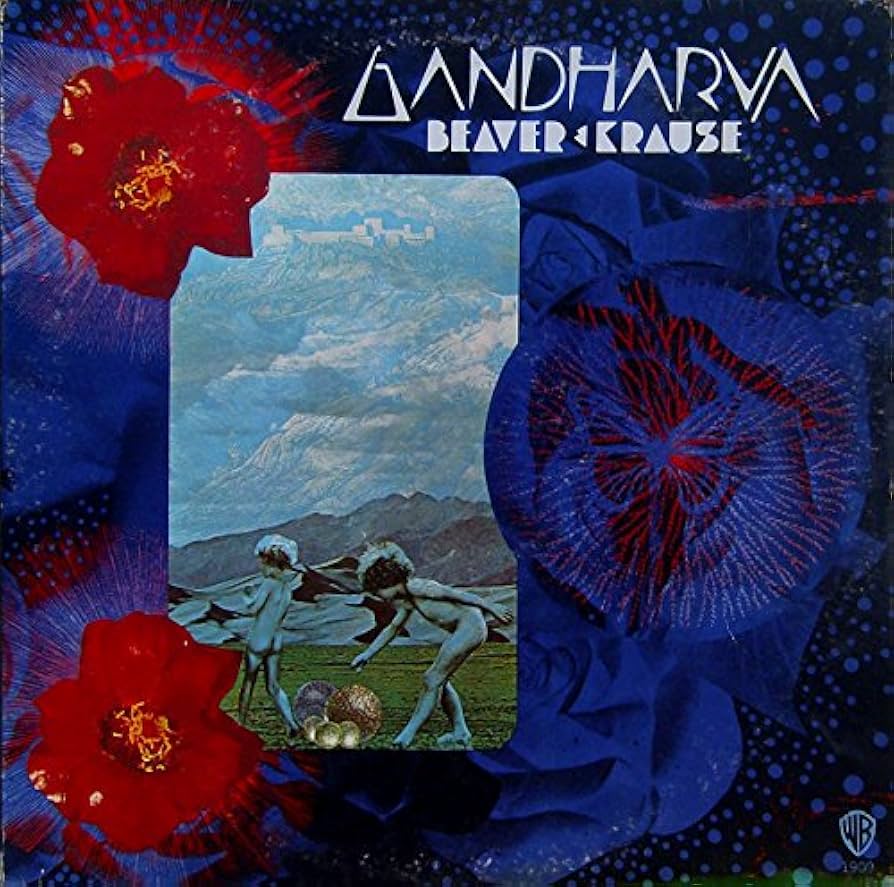 When I first encountered Beaver & Krause, I had no idea what to expect. The place itself felt wrong: a department store. And the object in question – the LP Gandharva – was lying on a bargain table for the equivalent of one pound sterling, right next to a Europa compilation called International Hit Parade and a battered James Last record.
At home, I could hardly believe what was coming out of the speakers of my Miracord turntable. The sounds were strange – but strangely compelling, almost magical. It felt like a soundtrack, yet even without understanding the liner notes it was clear that Gandharva wasn’t a film. Nor was it a rock record in any conventional sense.
Only much later did I realise that these peculiar tonalities were coming from a synthesizer. The instrument itself wasn’t entirely unfamiliar to me – I knew it from Hot Butter, where it sounded like a slightly broken Hammond organ, a quirky pop novelty. What I heard here, though, was something else entirely. At times Gandharva felt like music from a space opera. The album was also strangely two-faced: one side drifting towards blues rock and gospel, the other ethereal, meditative, almost weightless.
It’s not that, at the age of thirteen, I was actively searching for such sounds – Marc Bolan’s glitter suit was far more fascinating at the time. But even then, I was drawn to the stories behind the music, to the people who made it. A few years later, through friends and American magazines like Billboard, I began to shed some light on this synthetic darkness.
When electronic pioneer Paul Beaver met a man called Bernie Krause, the latter was still essentially a folk musician – and a guitarist, at that. Beaver, on the other hand, had already built a reputation as a sound designer. Pooling their savings, the two bought one of Bob Moog’s formidable machines. For a while, Beaver became something like an elite West Coast ambassador for Moog systems. As early as 1967, he was already astonishing young musicians at the Monterey Pop Festival.
Only then did I begin to understand what kind of visionary – and at the same time slightly odd – character Paul Beaver really was. I quickly identified him as the driving force behind the duo. Today it’s clear that he was among the first musicians to treat the Moog not as an effect, but as a fully-fledged musical system. His “customer zero” is said to have been Ray Manzarek of The Doors – a story I like so much that I’ve never felt the need to verify it.
Following Beaver’s trail, I was gradually drawn into a synthetic undertow that carried me far beyond my Hendrix-schooled guitar world. A parallel reality of sound began to open up, populated by other figures. Morton Subotnick, for instance, working with a similar yet fundamentally different machine – Don Buchla’s synthesizer. Or Mort Garson, who blended the astrological obsessions of American housewives with the ideals of the love-and-peace generation, releasing albums devoted to star signs under the title Zodiac: Cosmic Sounds. As ridiculous as that may sound, the results were extraordinary. I was completely hooked.
Garson, who did in fact work with Beaver, is often quoted as saying that Paul was the only person who treated the Moog like an instrument rather than “a UFO on vacation”.
Beaver himself remained an enigmatic figure to me. As early as 1968, he and Krause released what was essentially a Moog demonstration double album. At the same time, he worked with visionaries like Garson and rock musicians of all stripes – only to disappear repeatedly into the world of library music. He played on more of those records than any database could ever hope to document, most of them uncredited. Beaver was frequently referred to as “Hollywood’s Moog man”, supplying advertising music, film scores and jingles built entirely from modular synthesizers – all of this before the general public had any idea of the difference between an oscillator and a filter.
Somehow it always seemed clear to me that this couldn’t have been the reason why pioneers like Buchla or Moog had dreamed up such machines in the first place. You won’t find the cerebral approaches of Tangerine Dream or Kraftwerk, nor the epic qualities of the BBC Radiophonic Workshop, in Beaver’s work. What makes him a myth, at least for me, lies in the in-between spaces. Perhaps Beaver was simply the nerd who was too good, too early, to become a rock star.
Paul Beaver was no performer. No poster boy. And certainly no prophet – not even one armed with a Prophet synthesizer. He was a border-crosser. A pioneer who translated space and time into skewed, otherworldly sounds. Did he leave a permanent mark on the world of electronic music? Who knows. What seems certain is that he lived as a native within that sonic universe long before it was properly mapped.
Pay a visit to Jochen's record label - Bellerophon Records CLICK HERE
All copyrights reserved 2026
www.fruitsdemerrecords.com
www.fruitsdemerrecords.com