
CLICK TO VISIT OUR SHOP LATEST NEWS DISCOGRAPHY MEMBERS CLUB BLOG CONTACT US HOME

Henry Schneider writes for the expose.org website and has been buying and listening to records for a long, long time!
In 'Letter From America', Henry shares his musical journey...and this month he shares some of his musical education...

LEARNING HOW TO LISTEN
When people ask about my musical influences, they usually expect me to mention progressive rock, psychedelia, or the electronic music that eventually became such an important part of my life. The truth is that my musical education began long before I knew what any of those terms meant.
One of my earliest musical memories was seeing Disney's Fantasia. Like many children of my generation, I encountered it during one of its theatrical re-releases. I was captivated by The Sorcerer's Apprentice, Night on Bald Mountain, Beethoven's Pastoral Symphony, Tchaikovsky's Nutcracker Suite, and especially Stravinsky's The Rite of Spring. Long before I knew the names of the composers, I learned that music could create images, tell stories, and transport listeners to entirely different worlds.
Nor was Disney the only source of musical education. Like many children of the 1950s and 60s, I absorbed an astonishing amount of classical music through television and cartoons. Rossini's William Tell Overture arrived courtesy of The Lone Ranger. Bugs Bunny, Daffy Duck, Elmer Fudd and the rest of the Warner Brothers gang regularly borrowed from Rossini, Wagner, Liszt, Straus and countless others. We didn't know who the composers were, we simply knew the music. Looking back, classical music was woven into everyday life in ways that seem increasingly rare today.
Another important influence was my elementary school teacher, Miss McDaniel, who introduced our class to classical music (Beethoven, Bach, Brahms, Mozart, Tchaikovsky, etc.). What I remember most vividly is not the music itself, but my amazement at a classmate who could listen to a piece of music and immediately identify the time signature. This seemed like a superpower to me - rhythm has never been my strength. While my classmate was counting beats, I was imagining pictures, stories, and landscapes suggested by the music.
Music remained a constant presence throughout my childhood. In elementary school I performed in The King and I. At church, our choir director, Don McAfee, continually broadened our horizons. Under his direction I appeared in Menotti's Amahl and the Night Visitors, Britten's Noye's Fludde, and later Gilbert and Sullivan's The Mikado. Because my voice was in the middle of changing, I ended up singing the title role.
Looking back, I realize how fortunate I was. McAfee regularly recruited professional singers from New York City to perform with our choir. One of them was tenor Ernie Ern. At the time I simply assumed everybody's church choir worked this way.
Years later I learned that Don McAfee was also the composer of the Off-Broadway musical Great Scot!, based on the life of Robert Burns. The show premiered in New York in 1965 and is still available for production today. Don McAfee composed the musical Great Scot!, which debuted at Theatre Four in New York City in 1965.
McAfee also organized a youth group trip into New York City to see West Side Story. I still remember hearing the Rolling Stones' "Satisfaction" on the radio while we were driving into Manhattan. At the time Broadway, church music, classical music, and rock-and-roll seemed like entirely separate worlds. Only much later did I realize they were all becoming part of the same musical education.
Another teacher opened an entirely different door...
In junior high, Mr. Bowman introduced our class to recordings from the RCA Electronic Music Laboratory. Long before synthesizers became commonplace in popular music, we were listening to electronically generated sounds that bore little resemblance to anything I heard on the radio. I had no idea what I was hearing, but I knew it was fascinating.
Ironically, I originally wanted to play the flute. By fifth grade Miss McDaniel had left the school and a new music teacher had taken her place. He handed me a pencil, had me blow across the top, and quickly concluded that flute was not in my future. Instead, I was assigned the violin.
My violin career was short-lived. I missed the lesson on eighth notes because of an illness and never really recovered. Later I switched to saxophone and eventually to E-flat alto clarinet under Mr. Bowman's guidance. Looking back, it's amusing that the instrument I most wanted to learn would later become one of my favorite sounds in music.
By the time I arrived at the University of Virginia in 1970, all of these experiences had prepared me for something entirely new...I enrolled in courses on Twentieth Century Music and Electronic Music. Suddenly I was hearing Debussy, Stravinsky, Bartók, Schoenberg, Berg, Webern, Stockhausen, Berio, Cage, Varèse, Xenakis, Babbitt, Subotnick, and Pierre Henry.
Of all the Second Viennese School composers we encountered, Berg made the deepest impression on me. I still remember Wozzeck. Unlike some of the more abstract works we studied, Berg's opera combined modern musical language with genuine drama. Even when I didn't fully understand the technique, I understood the humanity.
In the class my professor offered a definition of music that has stayed with me ever since:
Music is sound events in time and space
At first I wasn't entirely sure what that meant. By the end of the semester I was beginning to understand.
One assignment in the Twentieth Century Music course required us to bring an example of jazz to class. I brought Traffic's "Giving to You" from Mr. Fantasy. My professor listened politely and informed me that what I had brought was not jazz. I disagreed then and still do. It may not have been jazz in the academic sense he had in mind, but it contained enough jazz influence to catch my ear. Looking back, the incident revealed that I was already less interested in categories than in connections. The borders between rock, jazz, classical, and experimental music were beginning to blur.
Then, our final assignment was multimedia that required us to combine images and music. My project used photographs of docks along the Hudson River near the Tappan Zee Bridge accompanied by The Doors' "When the Music's Over". In particular, I was drawn to Morrison's haunting line, "What have they done to the earth?" Looking back, I realize I was already experimenting with the relationship between images, ideas, and music.
Another student took a far different approach, screening an explicit film accompanied by music. The result was memorable, though probably not for the reasons intended. Even fifty-five years later, it remains one of those experiences that cannot be unseen.
The next year I enrolled in an electronic music course that introduced me to works such as Gesang der Jünglinge, Kontakte, Silver Apples of the Moon , The Wild Bull, Poème électronique, and Variations for a Door and a Sigh .
Our most challenging assignment in my electronic music course involved creating a musique concrète composition. We were given a magnetic tape of source sounds, we then had to cut the tape into fragments with razor blades, and physically reassemble the pieces according to a visual score. On paper this sounded straightforward. In practice it was maddening. It taught me that tape editing was far more difficult than it appeared. Every splice mattered. There was no Undo key waiting to rescue a bad decision. Fifty-five years later, anyone with a laptop can perform the same manipulations in minutes. The technology has changed dramatically. The creative challenge remains exactly the same.
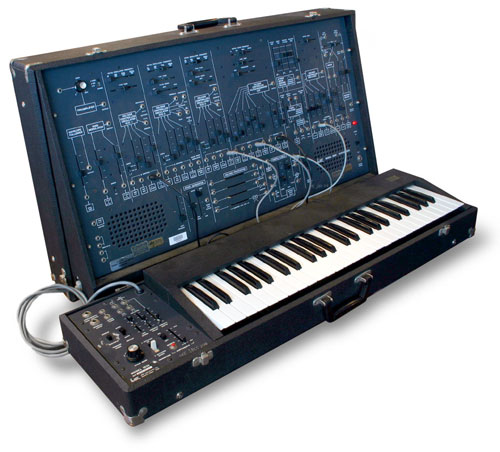 In March 1971 I was granted access to the university's ARP modular synthesizer. There were no presets and no memory banks. Every sound required patch cords connecting voltage-controlled oscillators, filters, amplifiers, and envelope generators. What fascinated me most was the primitive sequencer. By altering the speed of a sequence, a simple pattern could become something entirely different. I could hear connections to the tape manipulations we'd studied in works like Stockhausen's Gesang der Jünglinge, where familiar sounds were transformed into something new.
I recorded many of my ARP experiments and years later reused some of those sounds, along with recordings of thunder, rain, and various effects processors, to create sonic textures of my own. I was never much of a musician in the conventional sense. Rhythm remained elusive. What fascinated me was texture, atmosphere, and the relationship between sounds.
Two classmates took a more scientific approach. They attempted to synthesize the sound of a gong using a Univac computer and punch cards. Today anyone can download a gong sample in seconds. Back then the challenge was understanding what made a gong sound like a gong in the first place.
Around the same time, electronic music and rock music began to collide. I vividly remember hearing the first Emerson, Lake & Palmer album on New York FM radio. For the first time, synthesizers were escaping universities and research laboratories and becoming part of popular music.
Then in 1971 Fantasia returned to theaters and found a new audience among college students. Many attended under the influence of various substances and treated it as a psychedelic experience. I went with a classmate who fully embraced that approach. Everything was fine until The Rite of Spring arrived. When Stravinsky's pounding rhythms and stomping dinosaurs thundered across the screen, the experience proved far more intense than some audience members had anticipated. People retreated from the theater saying this “was too heavy.” Stravinsky, it seems, was still startling audiences nearly sixty years after the riotous premiere of the work itself.
Looking back more than half a century later, I realize these experiences taught me something far more important than the names of composers or the mechanics of synthesizers. My graduate education would later teach me how to learn. These early musical experiences taught me how to listen.
When I left Virginia for graduate school at Rice University in 1972, I thought I understood where my musical interests were heading. I was wrong. A period of musical drift lay ahead, followed by discoveries that included Karlheinz Stockhausen's Sirius, Robert Fripp's Frippertronics, and eventually the electronic visions of Klaus Schulze.
But that is another story.
more to come...
Check out Henry's previous article click here
All copyrights reserved 2026
www.fruitsdemerrecords.com
www.fruitsdemerrecords.com