
CLICK TO VISIT OUR SHOP LATEST NEWS DISCOGRAPHY MEMBERS CLUB BLOG CONTACT US HOME


Jochen Oberlack is a German writer, radio producer, musician and independent label owner behind the long-running project Rübenrock. His work explores pop music from its margins—studio culture, forgotten records and the intersections of art, technology and commerce.

Zeus B. Held – The Enabler
...or how to make music possible without stepping into the spotlight
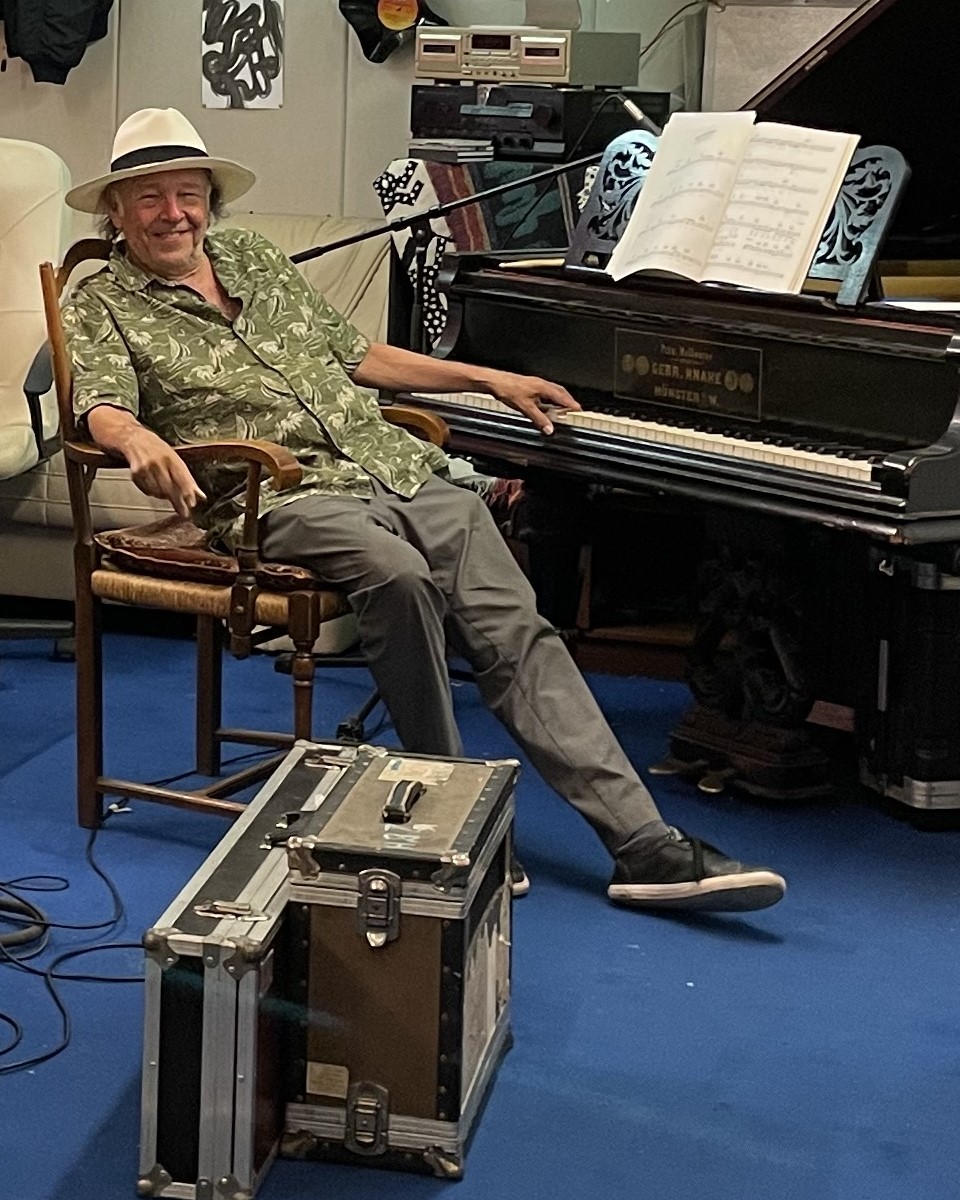 In the history of electronic music there are figures you recognise instantly – and others whose fingerprints only become clear once you listen more closely. Zeus B. Held belongs firmly to the second category. Not because he is invisible, but because he never set out to be visible. His work rarely unfolds in the spotlight, but in the spaces behind it: in the studio, in the arrangement, in the countless decisions that shape how something is allowed to sound.
I first met Zeus B. Held in Düsseldorf, at a music trade fair I happened to be moderating at the time. I was a nobody, though I did have an album out – and he took an immediate interest in it.
When Ralf Dörper joined us, I was the only one in the room who didn’t yet know that he and Zeus had long moved in the same Düsseldorf–London electronic orbit.
Why would I? They weren’t talking about career milestones. Zeus was simply making connections — just as he had done so many times before. That was, and still is, his nature.
It quickly became clear that we look at music from a similar angle. Not the same – that would be dull – but from a related direction. That years later we would release a record together with Mani Neumeier, The Secret Lives, was something neither of us could have known back then. But there are encounters where you sense immediately that someone doesn’t treat music as a question of style, but as an open space. Zeus is one of those people.
What fascinates me about him is difficult to put into words – perhaps because it isn’t something that pushes itself forward. It’s more like a movement that sets in as soon as he becomes part of a situation. Things begin to shift. Music somehow becomes wider, sometimes more physical, sometimes warmer, sometimes simply more plausible – without anyone needing to explain why.
Zeus is not someone you can pin down. Looking back, his career almost feels casual, even though it is full of striking moments. Perhaps that’s the key. He isn’t interested in boundaries. He’s interested in what’s possible – with whatever material happens to be at hand. Or with what, in the next creative moment, might simply be thought differently.
For him, technology is never an end in itself. It’s a tool that has to prove its worth – not in theory, but in the sonic space.
You can hear this most clearly when music stops being merely conceptual and becomes something you feel. When electronics no longer create distance, but proximity.
Take the Rockets, for example: suddenly blending space, Krautrock and a hint of Woodstock. Zeus gives them a robotic voice singing On the Road Again. On paper, it sounds bizarre – yet it feels entirely natural when Zeus is at the controls. He understands how far an idea can be pushed without betraying it.
That sensibility runs through everything he touches. He opens spaces. Sometimes all it takes is an instrument, sometimes a decision, sometimes simply the right way of listening. And then something happens that, in retrospect, can hardly be attributed to any single person – which may well be the greatest compliment. As with Fashion, whose post-punk he effortlessly distilled into electronic funk.
With Zeus, machines could dance.
That he was awarded the Holger Czukay Prize in Cologne a few years ago feels fitting. Not because he ever tried to work in the spirit of Czukay – instead they share something fundamental: a way of looking at music that doesn’t ask what is allowed, but what is possible. Structures, melodies, machines – it’s all material. What matters is what you do with it.
In that sense, “Musik, Music, Musique” – a central track on his 1979 album Europium – reads like a manifesto: music as a universal language, technologically expandable without losing its human core.
Even today, Zeus doesn’t come across as someone looking back at a completed body of work. When we sit together in Freiburg’s market hall or a beer garden, the conversation is always about new projects. The past is present, but only as a filter – the soil from which fresh ideas grow.
Keeping up with his pace isn’t always easy. Only at the piano, where he loses himself in sound like Sam in Rick’s Café, does a certain relaxed calm set in.
Artists like Zeus B. Held come from another time – yet they live firmly in the here and now. They have nothing to prove, but they question
everything every day, constantly re-contextualising and, above all, making things possible.
No pose. No grand gestures.
Just music, allowed to happen.
Perhaps that is his real gift:
Music. Music. Musique.
Enable it, Zeus.
Zeus B. Held (born 1950) is a German keyboard player, producer and arranger whose career spans more than five decades. From electronic experimentation and Krautrock to disco, post-punk and synth-pop, he has quietly helped shape the sound of countless recordings—always guided more by curiosity than by categories)
Editor’s Note
This essay became something of a conversation rather than a finished text.
Before publication, I asked Zeus B. Held to read it—not for approval, but because memory is a curious instrument. He corrected a few historical details, added some context and, perhaps most importantly, reminded me that history is rarely as tidy as it appears in retrospect.
What pleased me most was that our exchange quickly moved away from the past. Within minutes we were talking about new recordings, unfinished ideas and future collaborations. That, I realised, is probably the most accurate thing I could have written about Zeus: he has never become a museum piece. His curiosity still outruns his biography.
In that sense, “The Enabler” is not a role he once played. It is simply who he still is.
— Jochen Oberlack
Coming soon:
Ten Doorways into the World of Zeus B. Held
Pay a visit to Jochen's record label - Bellerophon Records CLICK HERE
Read Jochen's first post for Fruits de Mer... CLICK HERE
This essay became something of a conversation rather than a finished text.
Before publication, I asked Zeus B. Held to read it—not for approval, but because memory is a curious instrument. He corrected a few historical details, added some context and, perhaps most importantly, reminded me that history is rarely as tidy as it appears in retrospect.
What pleased me most was that our exchange quickly moved away from the past. Within minutes we were talking about new recordings, unfinished ideas and future collaborations. That, I realised, is probably the most accurate thing I could have written about Zeus: he has never become a museum piece. His curiosity still outruns his biography.
In that sense, “The Enabler” is not a role he once played. It is simply who he still is.
— Jochen Oberlack
Coming soon:
Ten Doorways into the World of Zeus B. Held
Read Jochen's first post for Fruits de Mer... CLICK HERE
All copyrights reserved 2026
www.fruitsdemerrecords.com
www.fruitsdemerrecords.com